
一、背景
随着AI技术的进一步发展,常见的如:微调等手段在前期的数据准备上已经有成熟的方案,但是对于企业数据的快速增长状态依然无法满足。> 也就是大多数的AI应用都卡在了资料库检索与模型记忆这两个方向,而RAG的出现,从侧面部分的解决了这个问题,当然:对于个人知识库来说,现在又更好的方案,一切皆Markdown格式化文本(注意:这里有个前提是个人小数据量开发者)。> 当然,作为RAG技术来说,数据检索可以有多种多样,比如:传统结构化数据(这是最佳的情况)。但我们在生产过程中产生的数据大多数是非结构化数据,如:一段长文本聊天、一篇文档、一张照片、一段音频,甚至一段视频文件。> 这时候通过向量数据检索的方案也就应运而生了,而通过支持向量检索的数据库也就应运而生了。
二、流程图
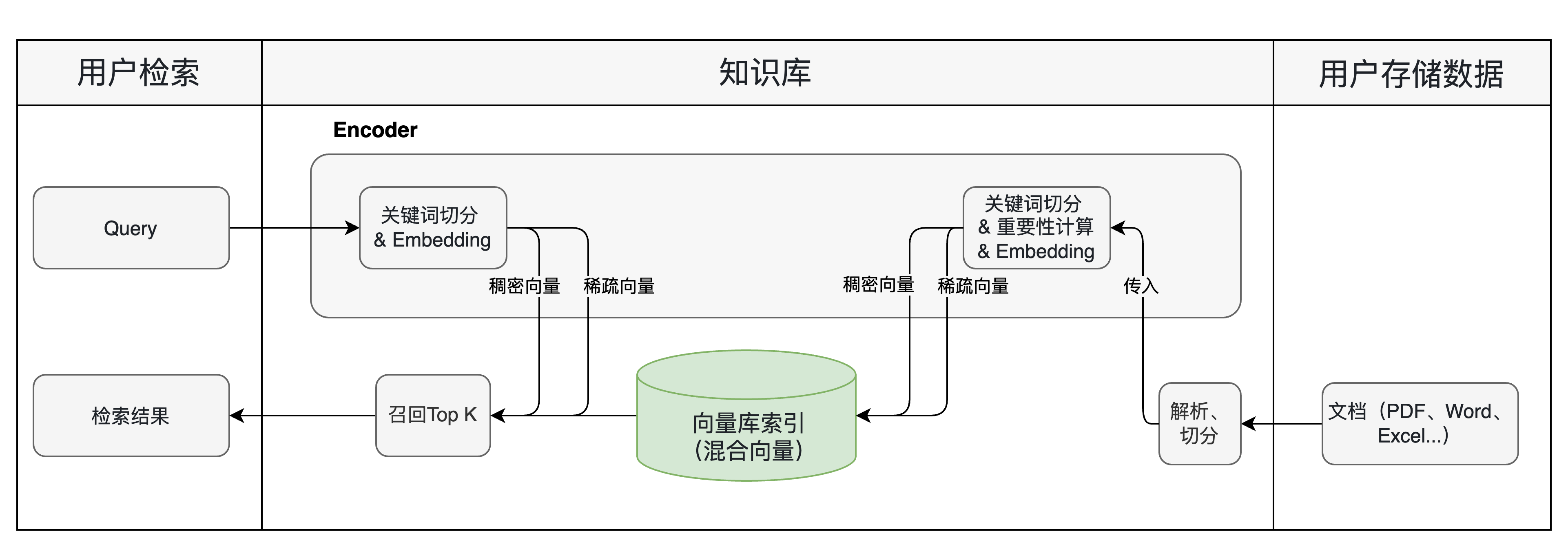
三、常见的向量数据库(简要,后面会专门针对常见的向量库出几篇文章以及示例)
3.1 Milvus
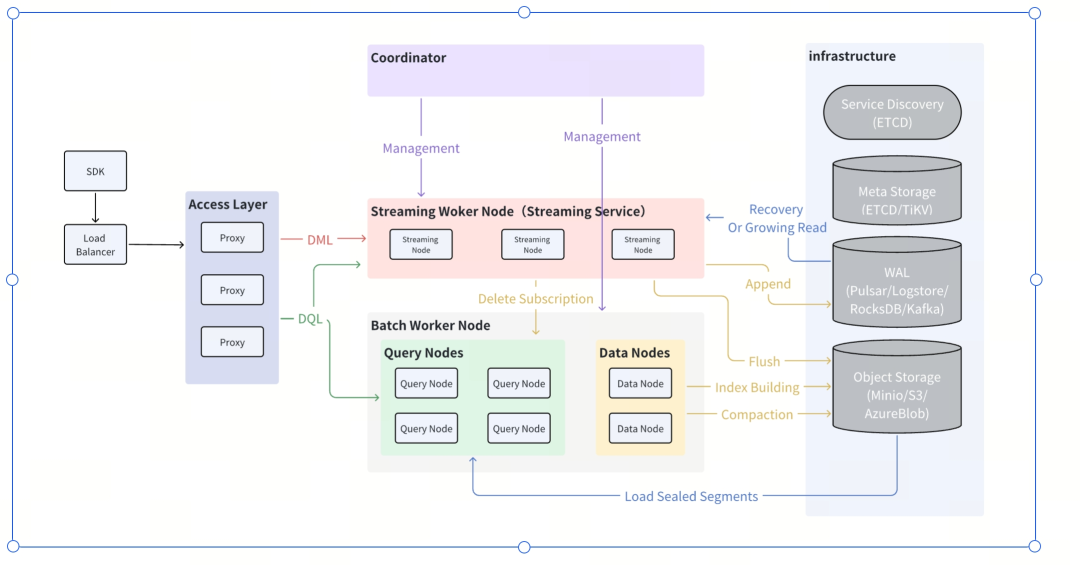
开源云原生向量数据库,高可用,高性能,易拓展,支持混合索引,采用存算分离的极致,计算节点可以横向扩展,用于海量数据检索。
-
架构
-
简单示例:
import io.milvus.client.MilvusClient; import io.milvus.param.*; import io.milvus.param.collection.SearchParam; import io.milvus.grpc.SearchResults; import io.milvus.grpc.SearchResultData; // 初始化客户端 MilvusClient client = new MilvusClient(ConnectParam.newBuilder() .withHost("localhost") .withPort(19530) .build()); // 构建搜索请求 SearchParam searchParam = SearchParam.newBuilder() .withCollectionName("docs") .withVectorFieldName("embedding") .withVectors(Collections.singletonList(queryVector)) .withMetricType(MetricType.COSINE) .withTopK(10) .withExpr("category == 'AI'") // 标量过滤 .build(); SearchResults results = client.search(searchParam); List<SearchResultData> resultData = results.getResults().getFieldsDataList(); -
优点:
- 分布式存储,存算分离,计算节点可以横向扩展,存储节点使用云原生对象存储
- 三级存储架构:内存层、本地缓存和对象存储
- 支持索引类型丰富:HNSW, IVF, DiskANN以及CAGRA(GPU加速)
- 支持混合搜索:向量、全文、标量过滤
-
缺点:
- 部署复杂
- 太过庞大: 对中小型数据规模来说,过于庞大就带来更多的维护问题以及成本问题
-
适用场景:
- 大规模图片、视频检索
- 大型平台推荐系统
- 大型企业RAG应用
3.1 Qdrant:我一只在使用的向量库
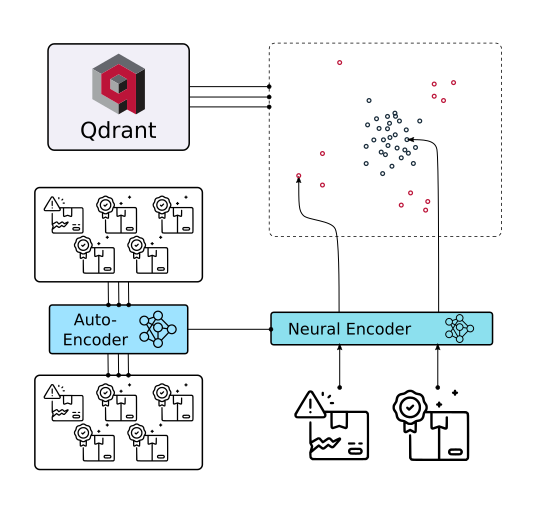
部署简单,支持常见的现代化索引,Rust带来的内存安全,性能不错,支持混合检索
-
架构图
-
先说优点:
- RUST开发:内存安全,性能不错
- 可组合设计:精确控制检索环节
- 支持稠密与稀疏向量混合使用
- 部署极为简单,占用资源很少,极适宜中小型数据规模使用
-
缺点:
- 不适宜大规模数据使用
- 非云原生
-
场景
- 中小型数据量,延迟低要求
- 个人知识库或者中小型企业知识库
- 边缘设备部署
- 我自己用着很舒服
3.3 pgvector
原postgresql的向量扩展库,依托于postgresql的生态支持,比如:扩展、事物支持等
这个库其实没什么说的,作为传统关系型数据库,在关系库上加入了对向量检索的支持,目前支持的索引有:IVFlat, HNSW如果有大量的结构化数据,并且对事物有较高的一致性要求,非机构化数据并不大,或者不需要大量的非结构化数据场景,这个库就是不二选择。
题外话:物理世界要求的是准确性,而不是非准确性,向量库虽然能解决非结构化数据的问题,但是结构化数据依然是对准确的物理世界可靠度量工具之一。对于大多数工业、数字、金融和政务行业来说,准确性依然是一个绕不过的门槛,AI如果要真正落地就已经要切近物理的真实世界,这个世界是非泛化的。
所以,pgvector作为关系型数据库,依然是企业场景下可选的工具之一
四、常见的向量库索引
Flat:准确索引
这个检索算法没什么可说的,要求准确性,对速度没太高要求,做Embedding基线测试都可以用
-
使用场景:
- 数据量不大的精确索引
- ANN评测极限
-
特点:
- 不做近似,全量比较
- 最准确
- 最慢
-
代码:
"""FAISS flat index 原生 API 使用示例。

直接调用 faiss 库,演示:
1. IndexFlatL2 / IndexFlatIP 的创建与搜索
2. IndexIDMap2 绑定自定义 ID
3. 向量增删、保存加载
4. 与 numpy 手写余弦相似度的结果对比
"""

from __future__ import annotations

import logging

import faiss
import numpy as np

logging.basicConfig(level=logging.INFO)
logger = logging.getLogger(__name__)


def cosine_similarity(a: np.ndarray, b: np.ndarray) -> float:
    dot = float(np.dot(a, b))
    norm_a = float(np.linalg.norm(a))
    norm_b = float(np.linalg.norm(b))
    if norm_a == 0.0 or norm_b == 0.0:
        return 0.0
    return dot / (norm_a * norm_b)


def brute_force_search(
    xb: np.ndarray, query: np.ndarray, top_k: int = 5
) -> list[tuple[int, float]]:
    scored = []
    for idx, vec in enumerate(xb):
        score = cosine_similarity(query, vec)
        scored.append((score, idx))
    scored.sort(key=lambda x: x[0], reverse=True)
    return [(idx, score) for score, idx in scored[:top_k]]


def main() -> None:
    dim = 128
    n_vectors = 100
    top_k = 5

    # 生成随机向量(已归一化,方便与 Inner Product 对比)
    xb = np.random.rand(n_vectors, dim).astype("float32")
    xb = xb / np.linalg.norm(xb, axis=1, keepdims=True)

    # 自定义 ID:0 ~ 99 映射到 1000 ~ 1099
    ids = np.arange(1000, 1000 + n_vectors, dtype="int64")

    query = np.random.rand(dim).astype("float32")
    query = query / np.linalg.norm(query)

    # =================== 1. IndexFlatIP(内积 = 余弦相似度,因已归一化) ===================
    logger.info("=== 1. IndexFlatIP(内积) ===")
    index_ip = faiss.IndexFlatIP(dim)
    index_ip_with_ids = faiss.IndexIDMap2(index_ip)
    index_ip_with_ids.add_with_ids(xb, ids)
    logger.info("总向量数: %d", index_ip_with_ids.ntotal)

    xq = query.reshape(1, -1)
    distances, indices = index_ip_with_ids.search(xq, top_k)
    for dist, idx in zip(distances[0], indices[0]):
        logger.info("  faiss_id=%d | inner_product=%.4f", idx, dist)

    # =================== 2. IndexFlatL2(欧氏距离) ===================
    logger.info("=== 2. IndexFlatL2(欧氏距离) ===")
    index_l2 = faiss.IndexFlatL2(dim)
    index_l2_with_ids = faiss.IndexIDMap2(index_l2)
    index_l2_with_ids.add_with_ids(xb, ids)

    distances_l2, indices_l2 = index_l2_with_ids.search(xq, top_k)
    for dist, idx in zip(distances_l2[0], indices_l2[0]):
        logger.info("  faiss_id=%d | l2_distance=%.4f", idx, dist)

    # =================== 3. 与 numpy 手写余弦相似度对比 ===================
    logger.info("=== 3. numpy 手写余弦相似度(Brute-Force) ===")
    brute_results = brute_force_search(xb, query, top_k)
    for idx, score in brute_results:
        logger.info("  idx=%d | cosine=%.4f | faiss_id=%d", idx, score, ids[idx])

    # =================== 4. 删除向量 ===================
    logger.info("=== 4. 删除向量 id=1000 ===")
    index_ip_with_ids.remove_ids(np.array([1000], dtype="int64"))
    logger.info("删除后总向量数: %d", index_ip_with_ids.ntotal)

    distances_after, indices_after = index_ip_with_ids.search(xq, top_k)
    for dist, idx in zip(distances_after[0], indices_after[0]):
        logger.info("  faiss_id=%d | inner_product=%.4f", idx, dist)

    # =================== 5. 保存 / 加载索引 ===================
    logger.info("=== 5. 保存 / 加载索引 ===")
    faiss.write_index(index_ip_with_ids, "/tmp/demo_flat_ip.index")
    loaded_index = faiss.read_index("/tmp/demo_flat_ip.index")
    logger.info("加载后总向量数: %d", loaded_index.ntotal)

    distances_loaded, indices_loaded = loaded_index.search(xq, top_k)
    for dist, idx in zip(distances_loaded[0], indices_loaded[0]):
        logger.info("  faiss_id=%d | inner_product=%.4f", idx, dist)

    # =================== 6. 批量查询 ===================
    logger.info("=== 6. 批量查询(3 条 query) ===")
    xq_batch = np.random.rand(3, dim).astype("float32")
    xq_batch = xq_batch / np.linalg.norm(xq_batch, axis=1, keepdims=True)
    distances_batch, indices_batch = loaded_index.search(xq_batch, top_k)
    for i in range(3):
        logger.info("  Query %d:", i)
        for dist, idx in zip(distances_batch[i], indices_batch[i]):
            logger.info("    faiss_id=%d | inner_product=%.4f", idx, dist)


if __name__ == "__main__":
    main()
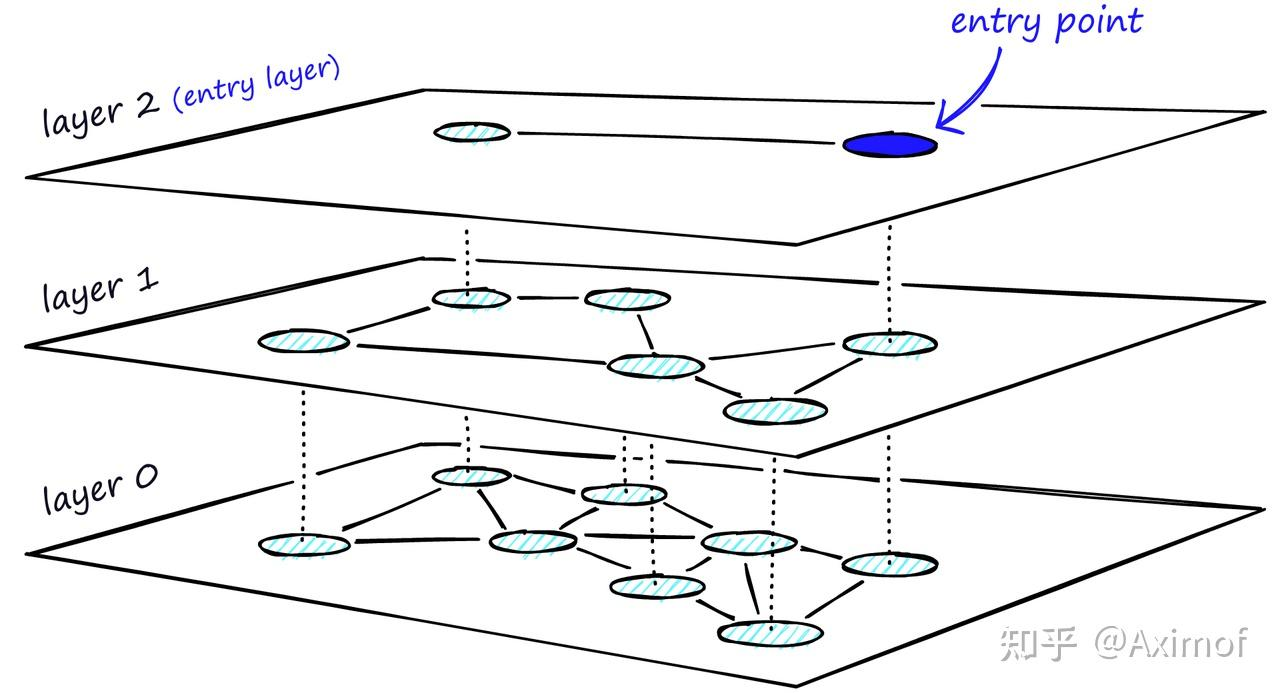
HNSW:Hierarchical Navigable Small Worlds
也是常见的索引类型,ANN算法中图的一种,结构也很好理解
-
场景:
- 大规模语义检索,内存规模较大(图带来的问题)
- 高recall要求
- 查询速度要快
-
特点:
- 图索引
- 查询快
- recall高
- 内存占用相对较高
-
核心参数
- m:每个节点最多多少个编,m越大,图越密,内存占用越高
- efConstruction:建图时搜索多宽,建图越慢,质量更高
- efSearch:查询时搜索多宽,查询更准确,但速度更慢
-
代码实现:
"""FAISS HNSW (Hierarchical Navigable Small World) 原生 API 使用示例。

直接调用 faiss 库,演示:
1. IndexHNSWFlat 的创建与搜索
2. efConstruction / efSearch 参数调优
3. 与 IndexFlatL2 的召回率与速度对比
4. 保存 / 加载索引
"""

from __future__ import annotations

import logging
import time

import faiss
import numpy as np

logging.basicConfig(level=logging.INFO)
logger = logging.getLogger(__name__)


def recall_at_k(
    ground_truth: np.ndarray, approx_results: np.ndarray, k: int
) -> float:
    """计算召回率:approx_results 中有多少命中 ground_truth 前 k 个。"""
    correct = 0
    total = 0
    for gt_row, app_row in zip(ground_truth, approx_results):
        gt_set = set(gt_row[:k])
        app_set = set(app_row[:k])
        correct += len(gt_set & app_set)
        total += k
    return correct / total


def main() -> None:
    dim = 128
    n_vectors = 10_000
    n_queries = 100
    top_k = 10
    hnsw_m = 32

    # 生成随机向量(未归一化,使用 L2 距离)
    logger.info("生成数据: %d 条向量, dim=%d", n_vectors, dim)
    xb = np.random.rand(n_vectors, dim).astype("float32")
    xq = np.random.rand(n_queries, dim).astype("float32")

    # =================== 1. 精确搜索(Flat L2)作为 ground truth ===================
    logger.info("=== 1. IndexFlatL2(精确搜索,作为 Ground Truth) ===")
    index_flat = faiss.IndexFlatL2(dim)
    index_flat.add(xb)

    t0 = time.perf_counter()
    distances_flat, indices_flat = index_flat.search(xq, top_k)
    flat_time = time.perf_counter() - t0
    logger.info("FlatL2 搜索耗时: %.4f s", flat_time)

    # =================== 2. HNSW Flat 索引 ===================
    logger.info("=== 2. IndexHNSWFlat(近似搜索) ===")
    index_hnsw = faiss.IndexHNSWFlat(dim, hnsw_m)
    # efConstruction: 建图时的搜索宽度,越大图质量越高,建图越慢
    index_hnsw.hnsw.efConstruction = 200
    index_hnsw.add(xb)
    logger.info("HNSW 图构建完成,总向量数: %d", index_hnsw.ntotal)

    # efSearch: 查询时的搜索宽度,越大召回率越高,查询越慢
    for ef in [16, 64, 200]:
        index_hnsw.hnsw.efSearch = ef
        t0 = time.perf_counter()
        distances_hnsw, indices_hnsw = index_hnsw.search(xq, top_k)
        hnsw_time = time.perf_counter() - t0
        recall = recall_at_k(indices_flat, indices_hnsw, top_k)
        logger.info(
            "  efSearch=%3d | 耗时=%.4f s | 召回率@10=%.2f%% | 加速比=%.1fx",
            ef,
            hnsw_time,
            recall * 100,
            flat_time / hnsw_time,
        )

    # =================== 3. HNSW + IDMap(支持自定义 ID) ===================
    logger.info("=== 3. IndexHNSWFlat + IDMap2(自定义 ID) ===")
    base_hnsw = faiss.IndexHNSWFlat(dim, hnsw_m)
    base_hnsw.hnsw.efConstruction = 200
    index_hnsw_id = faiss.IndexIDMap2(base_hnsw)
    ids = np.arange(1000, 1000 + n_vectors, dtype="int64")
    index_hnsw_id.add_with_ids(xb, ids)
    # IndexIDMap2 包装后需 downcast 才能访问底层 HNSW 属性
    hnsw_core = faiss.downcast_index(index_hnsw_id.index)
    hnsw_core.hnsw.efSearch = 64

    distances_id, indices_id = index_hnsw_id.search(xq[:5], top_k)
    for i in range(5):
        logger.info("  Query %d:", i)
        for dist, idx in zip(distances_id[i], indices_id[i]):
            logger.info("    faiss_id=%d | l2_distance=%.4f", idx, dist)

    # =================== 4. 保存 / 加载 HNSW 索引 ===================
    logger.info("=== 4. 保存 / 加载 HNSW 索引 ===")
    faiss.write_index(index_hnsw, "/tmp/demo_hnsw.index")
    loaded_hnsw = faiss.read_index("/tmp/demo_hnsw.index")
    logger.info("加载后总向量数: %d", loaded_hnsw.ntotal)

    loaded_hnsw.hnsw.efSearch = 64
    distances_loaded, indices_loaded = loaded_hnsw.search(xq[:3], top_k)
    for i in range(3):
        logger.info("  Query %d:", i)
        for dist, idx in zip(distances_loaded[i], indices_loaded[i]):
            logger.info("    idx=%d | l2_distance=%.4f", idx, dist)

    # =================== 5. 不同 M 参数对比 ===================
    logger.info("=== 5. 不同 M 参数(邻居数)对比 ===")
    for m in [8, 16, 32]:
        idx_hnsw = faiss.IndexHNSWFlat(dim, m)
        idx_hnsw.hnsw.efConstruction = 200
        idx_hnsw.add(xb)
        idx_hnsw.hnsw.efSearch = 64

        t0 = time.perf_counter()
        _, indices_m = idx_hnsw.search(xq, top_k)
        t_m = time.perf_counter() - t0
        recall_m = recall_at_k(indices_flat, indices_m, top_k)
        logger.info(
            "  M=%2d | 召回率@10=%.2f%% | 搜索耗时=%.4f s",
            m,
            recall_m * 100,
            t_m,
        )


if __name__ == "__main__":
    main()
IVF_FLAT:分桶后精确查询
相比较FLAT查询,IVF_FLAT引入了分桶查询,也就是先聚(K-Means)类再查询,相较于FLAT查询:
- 查询速度更快
- 近似查询
- 参数对查询结果影响比较大
-
参数:
- nlist:桶的数量,数量越多,查询结果越精确,速度越慢
- nprobe:查询桶数量,查询桶越多,越精确,速度越慢
-
场景:
- 数据量大于HNSW的极限
- 不想引入压缩误差,但是可接受一定的相似性查询
-
代码
"""FAISS IVF-Flat (Inverted File + Flat) 原生 API 使用示例。

直接调用 faiss 库,演示:
1. IndexIVFFlat 的创建、训练与搜索
2. nlist(聚类中心数)与 nprobe(查询时扫描的聚类数)调优
3. 与 IndexFlatL2 的召回率与速度对比
4. 保存 / 加载索引
"""

from __future__ import annotations

import logging
import time

import faiss
import numpy as np

logging.basicConfig(level=logging.INFO)
logger = logging.getLogger(__name__)


def recall_at_k(
    ground_truth: np.ndarray, approx_results: np.ndarray, k: int
) -> float:
    """计算召回率:approx_results 中有多少命中 ground_truth 前 k 个。"""
    correct = 0
    total = 0
    for gt_row, app_row in zip(ground_truth, approx_results):
        gt_set = set(gt_row[:k])
        app_set = set(app_row[:k])
        correct += len(gt_set & app_set)
        total += k
    return correct / total


def main() -> None:
    dim = 128
    n_vectors = 50_000
    n_queries = 200
    top_k = 10
    nlist = 100

    # 生成随机向量
    logger.info("生成数据: %d 条向量, dim=%d", n_vectors, dim)
    xb = np.random.rand(n_vectors, dim).astype("float32")
    xq = np.random.rand(n_queries, dim).astype("float32")

    # =================== 1. 精确搜索(Flat L2)作为 ground truth ===================
    logger.info("=== 1. IndexFlatL2(精确搜索,作为 Ground Truth) ===")
    index_flat = faiss.IndexFlatL2(dim)
    index_flat.add(xb)

    t0 = time.perf_counter()
    distances_flat, indices_flat = index_flat.search(xq, top_k)
    flat_time = time.perf_counter() - t0
    logger.info("FlatL2 搜索耗时: %.4f s", flat_time)

    # =================== 2. IVF-Flat 索引 ===================
    logger.info("=== 2. IndexIVFFlat(倒排 + Flat 精确搜索) ===")
    quantizer = faiss.IndexFlatL2(dim)
    index_ivf = faiss.IndexIVFFlat(quantizer, dim, nlist)

    # IVF 索引需要先训练(对 xb 做 k-means 聚类)
    logger.info("训练 IVF 索引 (nlist=%d)...", nlist)
    index_ivf.train(xb)
    index_ivf.add(xb)
    logger.info("IVF 索引构建完成,总向量数: %d, 是否训练: %s", index_ivf.ntotal, index_ivf.is_trained)

    # nprobe: 查询时扫描的聚类中心数,越大召回率越高,查询越慢
    for nprobe in [1, 5, 10, 50, 100]:
        index_ivf.nprobe = nprobe
        t0 = time.perf_counter()
        distances_ivf, indices_ivf = index_ivf.search(xq, top_k)
        ivf_time = time.perf_counter() - t0
        recall = recall_at_k(indices_flat, indices_ivf, top_k)
        logger.info(
            "  nprobe=%3d | 耗时=%.4f s | 召回率@10=%.2f%% | 加速比=%.1fx",
            nprobe,
            ivf_time,
            recall * 100,
            flat_time / ivf_time,
        )

    # =================== 3. IVF-Flat + IDMap(支持自定义 ID) ===================
    logger.info("=== 3. IndexIVFFlat + IDMap2(自定义 ID) ===")
    quantizer_id = faiss.IndexFlatL2(dim)
    base_ivf = faiss.IndexIVFFlat(quantizer_id, dim, nlist)
    base_ivf.train(xb)

    index_ivf_id = faiss.IndexIDMap2(base_ivf)
    ids = np.arange(1000, 1000 + n_vectors, dtype="int64")
    index_ivf_id.add_with_ids(xb, ids)
    # 通过 downcast 访问底层 IVF 的 nprobe
    faiss.downcast_index(index_ivf_id.index).nprobe = 10

    distances_id, indices_id = index_ivf_id.search(xq[:5], top_k)
    for i in range(5):
        logger.info("  Query %d:", i)
        for dist, idx in zip(distances_id[i], indices_id[i]):
            logger.info("    faiss_id=%d | l2_distance=%.4f", idx, dist)

    # =================== 4. 保存 / 加载 IVF 索引 ===================
    logger.info("=== 4. 保存 / 加载 IVF 索引 ===")
    faiss.write_index(index_ivf, "/tmp/demo_ivf_flat.index")
    loaded_ivf = faiss.read_index("/tmp/demo_ivf_flat.index")
    logger.info("加载后总向量数: %d, 是否训练: %s", loaded_ivf.ntotal, loaded_ivf.is_trained)

    loaded_ivf.nprobe = 10
    distances_loaded, indices_loaded = loaded_ivf.search(xq[:3], top_k)
    for i in range(3):
        logger.info("  Query %d:", i)
        for dist, idx in zip(distances_loaded[i], indices_loaded[i]):
            logger.info("    idx=%d | l2_distance=%.4f", idx, dist)

    # =================== 5. 不同 nlist 参数对比 ===================
    logger.info("=== 5. 不同 nlist(聚类中心数)对比 ===")
    for nl in [10, 50, 100, 200]:
        q = faiss.IndexFlatL2(dim)
        idx_ivf = faiss.IndexIVFFlat(q, dim, nl)
        idx_ivf.train(xb)
        idx_ivf.add(xb)
        idx_ivf.nprobe = 10

        t0 = time.perf_counter()
        _, indices_nl = idx_ivf.search(xq, top_k)
        t_nl = time.perf_counter() - t0
        recall_nl = recall_at_k(indices_flat, indices_nl, top_k)
        logger.info(
            "  nlist=%3d | 召回率@10=%.2f%% | 搜索耗时=%.4f s",
            nl,
            recall_nl * 100,
            t_nl,
        )


if __name__ == "__main__":
    main()
IVF_PQ:分桶压缩
相比较IVF_FLAT来说:PQ对分桶的数据进行了压缩
-
场景:
- 数据量很大
- 内存压力
- 可以接受精度损失
- 工业中比较常见:工业数据一般比较庞大,而且多数为时序数据,如某密度传感器等
-
核心参数:
- nlist:桶数
- m:向量PG段数
- nbits:每段编码多少bit
- nprobe:查询桶数
-
代码示例
"""FAISS IVF-PQ (Inverted File + Product Quantization) 原生 API 使用示例。

直接调用 faiss 库,演示:
1. IndexIVFPQ 的创建、训练与搜索
2. nprobe(查询聚类数)与 PQ 参数(m, nbits)调优
3. 与 IndexFlatL2 的召回率与速度对比
4. 保存 / 加载索引
"""

from __future__ import annotations

import logging
import time

import faiss
import numpy as np

logging.basicConfig(level=logging.INFO)
logger = logging.getLogger(__name__)


def recall_at_k(ground_truth: np.ndarray, approx_results: np.ndarray, k: int) -> float:
    """计算召回率:approx_results 中有多少命中 ground_truth 前 k 个。"""
    correct = 0
    total = 0
    for gt_row, app_row in zip(ground_truth, approx_results):
        gt_set = set(gt_row[:k])
        app_set = set(app_row[:k])
        correct += len(gt_set & app_set)
        total += k
    return correct / total


def main() -> None:
    dim = 128
    n_vectors = 50_000
    n_queries = 200
    top_k = 10
    nlist = 100
    m = 16  # PQ 子空间数,必须整除 dim (128)
    nbits = 8  # 每个子空间 8 bits => 256 个聚类中心

    # 生成随机向量
    logger.info("生成数据: %d 条向量, dim=%d", n_vectors, dim)
    xb = np.random.rand(n_vectors, dim).astype("float32")
    xq = np.random.rand(n_queries, dim).astype("float32")

    # =================== 1. 精确搜索(Flat L2)作为 ground truth ===================
    logger.info("=== 1. IndexFlatL2(精确搜索,作为 Ground Truth) ===")
    index_flat = faiss.IndexFlatL2(dim)
    index_flat.add(xb)

    t0 = time.perf_counter()
    distances_flat, indices_flat = index_flat.search(xq, top_k)
    flat_time = time.perf_counter() - t0
    logger.info("FlatL2 搜索耗时: %.4f s", flat_time)

    # =================== 2. IVF-PQ 索引 ===================
    logger.info("=== 2. IndexIVFPQ(倒排 + 乘积量化) ===")
    quantizer = faiss.IndexFlatL2(dim)
    index_ivfpq = faiss.IndexIVFPQ(quantizer, dim, nlist, m, nbits)

    # IVF-PQ 索引需要先训练(k-means + PQ 码本学习)
    logger.info("训练 IVF-PQ 索引 (nlist=%d, m=%d, nbits=%d)...", nlist, m, nbits)
    index_ivfpq.train(xb)
    index_ivfpq.add(xb)
    logger.info(
        "IVF-PQ 索引构建完成,总向量数: %d, 是否训练: %s",
        index_ivfpq.ntotal,
        index_ivfpq.is_trained,
    )

    # nprobe: 查询时扫描的聚类中心数,越大召回率越高,查询越慢
    for nprobe in [1, 5, 10, 50, 100]:
        index_ivfpq.nprobe = nprobe
        t0 = time.perf_counter()
        distances_ivfpq, indices_ivfpq = index_ivfpq.search(xq, top_k)
        ivfpq_time = time.perf_counter() - t0
        recall = recall_at_k(indices_flat, indices_ivfpq, top_k)
        logger.info(
            "  nprobe=%3d | 耗时=%.4f s | 召回率@10=%.2f%% | 加速比=%.1fx",
            nprobe,
            ivfpq_time,
            recall * 100,
            flat_time / ivfpq_time,
        )

    # =================== 3. IVF-PQ + IDMap(支持自定义 ID) ===================
    logger.info("=== 3. IndexIVFPQ + IDMap2(自定义 ID) ===")
    quantizer_id = faiss.IndexFlatL2(dim)
    base_ivfpq = faiss.IndexIVFPQ(quantizer_id, dim, nlist, m, nbits)
    base_ivfpq.train(xb)

    index_ivfpq_id = faiss.IndexIDMap2(base_ivfpq)
    ids = np.arange(1000, 1000 + n_vectors, dtype="int64")
    index_ivfpq_id.add_with_ids(xb, ids)
    # 通过 downcast 访问底层 IVF 的 nprobe
    faiss.downcast_index(index_ivfpq_id.index).nprobe = 10

    distances_id, indices_id = index_ivfpq_id.search(xq[:5], top_k)
    for i in range(5):
        logger.info("  Query %d:", i)
        for dist, idx in zip(distances_id[i], indices_id[i]):
            logger.info("    faiss_id=%d | l2_distance=%.4f", idx, dist)

    # =================== 4. 保存 / 加载 IVF-PQ 索引 ===================
    logger.info("=== 4. 保存 / 加载 IVF-PQ 索引 ===")
    faiss.write_index(index_ivfpq, "/tmp/demo_ivfpq.index")
    loaded_ivfpq = faiss.read_index("/tmp/demo_ivfpq.index")
    logger.info(
        "加载后总向量数: %d, 是否训练: %s",
        loaded_ivfpq.ntotal,
        loaded_ivfpq.is_trained,
    )

    loaded_ivfpq.nprobe = 10
    distances_loaded, indices_loaded = loaded_ivfpq.search(xq[:3], top_k)
    for i in range(3):
        logger.info("  Query %d:", i)
        for dist, idx in zip(distances_loaded[i], indices_loaded[i]):
            logger.info("    idx=%d | l2_distance=%.4f", idx, dist)

    # =================== 5. 不同 m(子空间数)对比 ===================
    logger.info("=== 5. 不同 m(PQ 子空间数)对比 ===")
    for m_test in [8, 16, 32]:
        q = faiss.IndexFlatL2(dim)
        idx_ivfpq = faiss.IndexIVFPQ(q, dim, nlist, m_test, nbits)
        idx_ivfpq.train(xb)
        idx_ivfpq.add(xb)
        idx_ivfpq.nprobe = 10

        t0 = time.perf_counter()
        _, indices_m = idx_ivfpq.search(xq, top_k)
        t_m = time.perf_counter() - t0
        recall_m = recall_at_k(indices_flat, indices_m, top_k)
        logger.info(
            "  m=%2d | 召回率@10=%.2f%% | 搜索耗时=%.4f s | 内存=%d bytes",
            m_test,
            recall_m * 100,
            t_m,
            idx_ivfpq.sa_encode(xb[:1]).nbytes * n_vectors // 1,
        )

    # =================== 6. 不同 nbits(量化位数)对比 ===================
    logger.info("=== 6. 不同 nbits(量化位数)对比 ===")
    for nbits_test in [4, 8]:
        q = faiss.IndexFlatL2(dim)
        idx_ivfpq = faiss.IndexIVFPQ(q, dim, nlist, m, nbits_test)
        idx_ivfpq.train(xb)
        idx_ivfpq.add(xb)
        idx_ivfpq.nprobe = 10

        t0 = time.perf_counter()
        _, indices_nb = idx_ivfpq.search(xq, top_k)
        t_nb = time.perf_counter() - t0
        recall_nb = recall_at_k(indices_flat, indices_nb, top_k)
        logger.info(
            "  nbits=%1d | 召回率@10=%.2f%% | 搜索耗时=%.4f s",
            nbits_test,
            recall_nb * 100,
            t_nb,
        )


if __name__ == "__main__":
    main()
DiskANN:磁盘ANN索引
字面意思,有点像Mysql的InnoDB
-
场景
- 数据量级非常大
- 内存无法下方到全部索引数据
- 仍然希望快速索引
-
特点
- 核心目标是减少随机磁盘访问
- 适合超大规模检索
- 更偏生产级大规模系统
-
示例
"""DiskANN-style Vamana 图索引(简化教学实现)。

纯 Python + NumPy 实现,演示 DiskANN 核心原理:
1. Vamana 图构建(随机初始化 + 贪婪搜索 + RobustPrune)
2. 贪婪搜索查询
3. 参数调优(R, L, alpha)
4. 召回率与速度对比
5. 保存 / 加载索引
"""

from __future__ import annotations

import logging
import random
import time
from typing import Any

import numpy as np

logging.basicConfig(level=logging.INFO)
logger = logging.getLogger(__name__)


def recall_at_k(ground_truth: np.ndarray, approx_results: np.ndarray, k: int) -> float:
    """计算召回率:approx_results 中有多少命中 ground_truth 前 k 个。"""
    correct = 0
    total = 0
    for gt_row, app_row in zip(ground_truth, approx_results):
        gt_set = set(gt_row[:k])
        app_set = set(app_row[:k])
        correct += len(gt_set & app_set)
        total += k
    return correct / total


class VamanaIndex:
    """简化版 Vamana 图索引(DiskANN 核心算法教学实现)。

    参数:
        dim: 向量维度
        R: 最大出度(每个节点的最大邻居数)
        L: 搜索列表大小(构建和搜索时的候选集大小)
        alpha: 鲁棒性修剪阈值(>1,越大图越稀疏)
    """

    def __init__(self, dim: int, R: int = 16, L: int = 32, alpha: float = 1.2) -> None:
        self.dim = dim
        self.R = R
        self.L = L
        self.alpha = alpha
        self.vectors: np.ndarray | None = None
        self.graph: list[set[int]] = []
        self.medoid: int = 0

    def _euclidean_distance(self, x: np.ndarray, y: np.ndarray) -> float:
        """计算两个向量间的欧氏距离。"""
        return float(np.linalg.norm(x - y))

    def _greedy_search(
        self, query: np.ndarray, k: int, start_node: int | None = None
    ) -> tuple[list[float], list[int]]:
        """贪婪搜索:从入口点开始,逐步走向查询向量。"""
        if self.vectors is None:
            raise RuntimeError("Index not built yet")

        entry = self.medoid if start_node is None else start_node
        # 候选集:已发现但未扩展的节点,按到 query 的距离排序
        candidates: list[tuple[float, int]] = [
            (self._euclidean_distance(self.vectors[entry], query), entry)
        ]
        visited: set[int] = {entry}
        results: list[tuple[float, int]] = []

        while candidates:
            # 取出距离 query 最近的候选
            dist, node = candidates.pop(0)
            results.append((dist, node))

            # 如果当前结果集已超过 L,且最远的都比候选里最近还近,停止
            if len(results) >= self.L:
                farthest_in_results = max(results[: self.L], key=lambda x: x[0])
                if not candidates or farthest_in_results[0] < candidates[0][0]:
                    break

            # 扩展邻居
            for neighbor in self.graph[node]:
                if neighbor in visited:
                    continue
                visited.add(neighbor)
                ndist = self._euclidean_distance(self.vectors[neighbor], query)
                # 插入排序到 candidates
                inserted = False
                for i, (cdist, _) in enumerate(candidates):
                    if ndist < cdist:
                        candidates.insert(i, (ndist, neighbor))
                        inserted = True
                        break
                if not inserted:
                    candidates.append((ndist, neighbor))

        # 返回前 k 个
        results.sort(key=lambda x: x[0])
        distances = [d for d, _ in results[:k]]
        indices = [i for _, i in results[:k]]
        return distances, indices

    def _robust_prune(self, point_idx: int, candidate_pool: set[int]) -> set[int]:
        """鲁棒性修剪:从候选池中选择最多 R 个邻居,保证 alpha-可达性。"""
        if self.vectors is None:
            raise RuntimeError("Index not built yet")

        candidates = list(candidate_pool - {point_idx})
        # 按到 point_idx 的距离排序
        candidates.sort(
            key=lambda n: self._euclidean_distance(
                self.vectors[point_idx], self.vectors[n]
            )
        )

        new_neighbors: set[int] = set()
        for c in candidates:
            if len(new_neighbors) >= self.R:
                break
            # alpha-条件:如果存在已选邻居 p,使得 dist(c, p) < alpha * dist(point, c)
            # 则 c 可以通过 p 到达,不需要直接连接
            point_dist = self._euclidean_distance(
                self.vectors[point_idx], self.vectors[c]
            )
            dominated = False
            for p in new_neighbors:
                cross_dist = self._euclidean_distance(self.vectors[c], self.vectors[p])
                if cross_dist < self.alpha * point_dist:
                    dominated = True
                    break
            if not dominated:
                new_neighbors.add(c)
        return new_neighbors

    def build(self, vectors: np.ndarray) -> None:
        """构建 Vamana 图索引。"""
        n = vectors.shape[0]
        self.vectors = vectors.astype("float32")
        logger.info(
            "构建 Vamana 图: n=%d, dim=%d, R=%d, L=%d", n, self.dim, self.R, self.L
        )

        # 1. 找到 medoid(到所有其他点距离之和最小的点)作为搜索入口
        logger.info("计算 medoid...")
        # 简化:用随机子集估计 medoid
        sample_size = min(n, 500)
        sample_indices = np.random.choice(n, sample_size, replace=False)
        sample = self.vectors[sample_indices]
        # 计算样本间距离矩阵
        dists = np.linalg.norm(
            sample[:, np.newaxis, :] - sample[np.newaxis, :, :], axis=2
        )
        medoid_sample_idx = int(np.argmin(dists.sum(axis=1)))
        self.medoid = int(sample_indices[medoid_sample_idx])
        logger.info("Medoid: %d", self.medoid)

        # 2. 初始化随机图(每个节点连接 R 个随机邻居)
        logger.info("初始化随机图...")
        self.graph = []
        for i in range(n):
            neighbors = set()
            while len(neighbors) < min(self.R, n - 1):
                j = random.randint(0, n - 1)
                if j != i:
                    neighbors.add(j)
            self.graph.append(neighbors)

        # 3. Vamana 优化:迭代改进图质量
        logger.info("优化图结构(1 轮)...")
        permutation = list(range(n))
        random.shuffle(permutation)

        for idx, i in enumerate(permutation):
            if idx % 1000 == 0 and idx > 0:
                logger.info("  已处理 %d/%d", idx, n)

            # 贪婪搜索找到 L 个候选
            query = self.vectors[i]
            _, candidates = self._greedy_search(query, self.L, start_node=self.medoid)
            candidate_pool = set(candidates)
            # 加入当前邻居
            candidate_pool |= self.graph[i]

            # RobustPrune 重新选择邻居
            new_neighbors = self._robust_prune(i, candidate_pool)
            self.graph[i] = new_neighbors

            # 双向添加边
            for j in new_neighbors:
                self.graph[j].add(i)
                if len(self.graph[j]) > self.R:
                    # 如果超出度数限制,对 j 也做修剪
                    self.graph[j] = self._robust_prune(j, self.graph[j] | {i})

        logger.info("Vamana 图构建完成")

    def search(self, queries: np.ndarray, k: int) -> tuple[np.ndarray, np.ndarray]:
        """批量搜索。"""
        if self.vectors is None:
            raise RuntimeError("Index not built yet")

        nq = queries.shape[0]
        all_distances = np.zeros((nq, k), dtype="float32")
        all_indices = np.zeros((nq, k), dtype="int64")

        for i in range(nq):
            distances, indices = self._greedy_search(queries[i], k)
            # 如果结果不足 k,用 -1 和 inf 填充
            while len(indices) < k:
                indices.append(-1)
                distances.append(float("inf"))
            all_distances[i] = distances[:k]
            all_indices[i] = indices[:k]

        return all_distances, all_indices

    def save(self, path: str) -> None:
        """保存索引到文件(NPZ 格式)。"""
        if self.vectors is None:
            raise RuntimeError("Index not built yet")

        # 将 set 转换为 list 以便序列化
        graph_lists = [list(neighbors) for neighbors in self.graph]
        max_len = max(len(g) for g in graph_lists)
        # 填充到等长以便存为数组
        graph_array = np.full((len(graph_lists), max_len), -1, dtype="int32")
        for i, g in enumerate(graph_lists):
            graph_array[i, : len(g)] = g

        np.savez(
            path,
            vectors=self.vectors,
            graph=graph_array,
            medoid=self.medoid,
            dim=self.dim,
            R=self.R,
            L=self.L,
            alpha=self.alpha,
        )
        logger.info("索引已保存到 %s", path)

    def load(self, path: str) -> None:
        """从文件加载索引。"""
        data: Any = np.load(path)
        self.vectors = data["vectors"]
        self.dim = int(data["dim"])
        self.R = int(data["R"])
        self.L = int(data["L"])
        self.alpha = float(data["alpha"])
        self.medoid = int(data["medoid"])

        # 将数组还原为 set 列表
        graph_array = data["graph"]
        self.graph = []
        for row in graph_array:
            neighbors = {int(x) for x in row if x >= 0}
            self.graph.append(neighbors)
        logger.info("索引已从 %s 加载,n=%d", path, len(self.graph))


def main() -> None:
    dim = 64
    n_vectors = 5_000
    n_queries = 100
    top_k = 10

    # 生成随机向量
    logger.info("生成数据: %d 条向量, dim=%d", n_vectors, dim)
    xb = np.random.rand(n_vectors, dim).astype("float32")
    xq = np.random.rand(n_queries, dim).astype("float32")

    # =================== 1. 精确搜索(暴力 Flat L2)作为 ground truth ===================
    logger.info("=== 1. FlatL2(精确搜索,作为 Ground Truth) ===")
    flat_dists = np.linalg.norm(xb[:, np.newaxis, :] - xq[np.newaxis, :, :], axis=2)
    indices_flat = np.argsort(flat_dists, axis=0)[:top_k].T
    # 计算 FlatL2 耗时(模拟)
    t0 = time.perf_counter()
    for _ in range(5):
        _ = np.argsort(
            np.linalg.norm(xb[:, np.newaxis, :] - xq[np.newaxis, :, :], axis=2),
            axis=0,
        )[:top_k]
    flat_time = (time.perf_counter() - t0) / 5
    logger.info("FlatL2 搜索耗时: %.4f s", flat_time)

    # =================== 2. Vamana 图索引 ===================
    logger.info("=== 2. Vamana 图索引(DiskANN 核心) ===")
    index = VamanaIndex(dim=dim, R=12, L=32, alpha=1.2)
    index.build(xb)

    t0 = time.perf_counter()
    distances_vamana, indices_vamana = index.search(xq, top_k)
    vamana_time = time.perf_counter() - t0
    recall = recall_at_k(indices_flat, indices_vamana, top_k)
    logger.info(
        "Vamana 搜索耗时: %.4f s | 召回率@10=%.2f%% | 加速比=%.1fx",
        vamana_time,
        recall * 100,
        flat_time / vamana_time,
    )

    # =================== 3. 参数调优:不同 L(搜索列表大小) ===================
    logger.info("=== 3. 不同 L(搜索列表大小)对比 ===")
    for L in [8, 16, 32, 64]:
        idx = VamanaIndex(dim=dim, R=12, L=L, alpha=1.2)
        idx.build(xb)

        t0 = time.perf_counter()
        _, indices_L = idx.search(xq, top_k)
        t_L = time.perf_counter() - t0
        recall_L = recall_at_k(indices_flat, indices_L, top_k)
        logger.info(
            "  L=%2d | 召回率@10=%.2f%% | 搜索耗时=%.4f s",
            L,
            recall_L * 100,
            t_L,
        )

    # =================== 4. 参数调优:不同 R(最大出度) ===================
    logger.info("=== 4. 不同 R(最大出度)对比 ===")
    for R in [4, 8, 16, 24]:
        idx = VamanaIndex(dim=dim, R=R, L=32, alpha=1.2)
        idx.build(xb)

        t0 = time.perf_counter()
        _, indices_R = idx.search(xq, top_k)
        t_R = time.perf_counter() - t0
        recall_R = recall_at_k(indices_flat, indices_R, top_k)
        logger.info(
            "  R=%2d | 召回率@10=%.2f%% | 搜索耗时=%.4f s",
            R,
            recall_R * 100,
            t_R,
        )

    # =================== 5. 参数调优:不同 alpha(修剪阈值) ===================
    logger.info("=== 5. 不同 alpha(修剪阈值)对比 ===")
    for alpha in [1.0, 1.2, 1.5, 2.0]:
        idx = VamanaIndex(dim=dim, R=12, L=32, alpha=alpha)
        idx.build(xb)

        t0 = time.perf_counter()
        _, indices_a = idx.search(xq, top_k)
        t_a = time.perf_counter() - t0
        recall_a = recall_at_k(indices_flat, indices_a, top_k)
        logger.info(
            "  alpha=%.1f | 召回率@10=%.2f%% | 搜索耗时=%.4f s",
            alpha,
            recall_a * 100,
            t_a,
        )

    # =================== 6. 保存 / 加载索引 ===================
    logger.info("=== 6. 保存 / 加载 Vamana 索引 ===")
    index.save("/tmp/demo_vamana.index")

    loaded = VamanaIndex(dim=dim)
    loaded.load("/tmp/demo_vamana.index")
    logger.info("加载后总向量数: %d", loaded.vectors.shape[0])

    _, indices_loaded = loaded.search(xq[:3], top_k)
    for i in range(3):
        logger.info("  Query %d:", i)
        for idx in indices_loaded[i]:
            logger.info("    idx=%d", idx)


if __name__ == "__main__":
    main()
五、总结
现实业务中,可以根据以上索引的特点进行选择,大致可分为以下(从前面到后,准确性到数据规模):
- Flat:准确、最慢
- HNSW:高召回,低延迟
- IVF_FLAT:分桶检索
- IVF_PQ:分桶压缩
- DiskANN:磁盘ANN